
Understanding what is VAT exempt in the UK enables businesses to save thousands of pounds every year. A lot of business owners and consumers have a hard time differentiating between exempt, zero-rated, and normal VAT products. This misunderstanding can lead to incorrect pricing. Whether it is selling cleaning products, offering insurance services, or a charity, it is important to know what items can be excluded.
This is a detailed guide that elaborates on the list of goods VAT exempt in the UK, giving a clear distinction between exempt and zero-rated goods. Also, it lets you know what you pay in terms of VAT. You will clearly understand how these provisions impact your business or purchases by the end of it.
What Does VAT Exempt in the UK Mean?
VAT exempt refers to the fact that there is no VAT levied on specific goods and services. Exempted means you cannot charge VAT on your prices, and you cannot reclaim VAT on the purchases you make.
This is unlike the zero-rated items. Exempt goods cannot be voluntarily registered in businesses that sell them. They also lose the input VAT on their business expenses.
These exemptions are established by the government to bring the most important services closer to people. Products such as healthcare, education, and insurance are included under this category since they are beneficial to society.
What Do You Pay VAT On?
In the UK, most services and goods are subject to VAT at 20%. These are liable to VAT at one of the three following rates:
- Standard rate (20%) – electronics, furniture, alcohol
- Reduced rate (5%) – domestic energy, child car seats
- Zero rate (0%) – food, books, children’s clothing
Looking for a VAT expert? Turn to Accounting Firms! It is the UK’s only instant Accountancy & Taxation Fee Comparison Website, where you can search, compare profiles, and read reviews of VAT experts to get the perfect fit for your business. Register today to get in touch with them- For Free!
Difference between Zero-Rated vs VAT Exempt in The UK
Zero-rated and exempt items are often mixed up by many people, although they differ in their operation in a very distinct way.
The zero-rated items are subject to 0% VAT rate. Registration of VAT and reclaiming input VAT on business expenditure is still open. This is the case with most food products, children’s clothing, and books.
Items that are exempted are not subject to any VAT, however, you are not able to reclaim VAT on related costs. This is in case of insurance, finance services, and some property transactions.
What do you know about the exemption of your sales from VAT or zero-rated? See the official lists of HMRC Exemptions or refer to an accountant.
What are the Exempt Goods and Services?
According to HMRC, there are some goods and services that are exempt from VAT. These include:
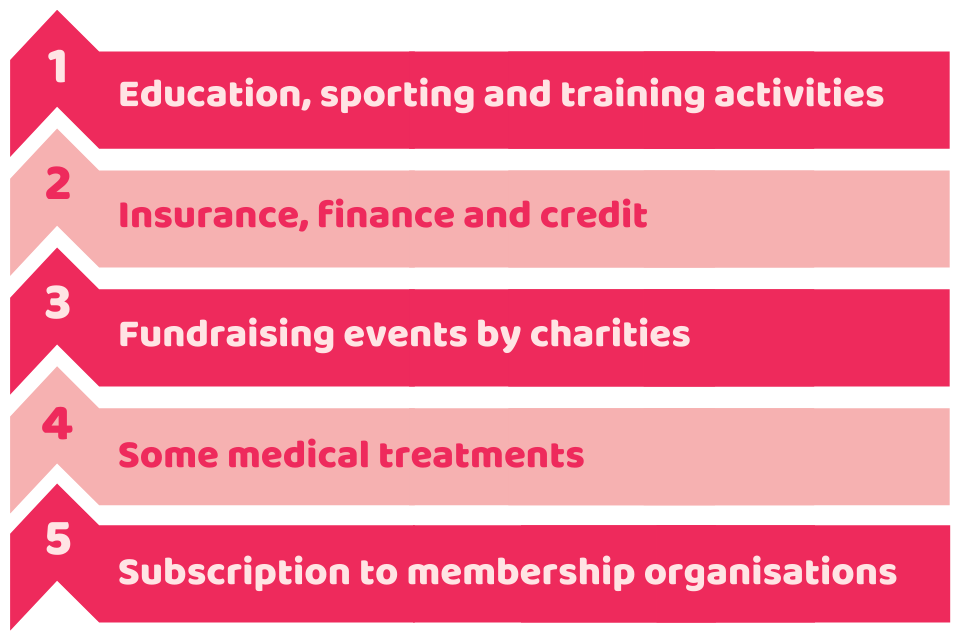
-
Financial and Insurance Services
The majority of financial services are VAT-free. This involves management of bank accounts, loan facilities, credit facilities, and insurance facilities. Insurance brokers do not charge VAT on most insurance commissions.
Even debt collection and debt management are exempted. Investment fund management is also tax-free, so such services are now more affordable to consumers.
-
Healthcare and Medical Services
VAT exemption is applied to NHS and private medical services. This includes GP visits, hospital care, dental services, and optician services. Prescription drugs are not taxed, but over-the-counter (OTC) drugs have other regulations.
VAT exempt in the UK are also offered to physiotherapists, chiropractors, and other medical practitioners as long as they qualify. The ultimate purpose is to keep the patient’s health intact.
-
Education and Training
Educational institutions offering courses that result in qualifications are tax-free. This incorporates universities, colleges, schools, and accredited training organisations. School tuition provided by eligible educational institutions is VAT exempt.
VAT is normally subject to recreational courses, such as a pottery course or a dance course. There is also an exemption from exam fees that are charged by qualifying bodies.
-
Property Transactions
Residential property is not subject to VAT when sold or leased. This is applicable to residential properties such as houses, flats, and long-term residential rentals. The exemption of commercial property may depend on the situation. The owners of the property, however, have the option of taxing commercial buildings with this. Well, they are taxed as ordinary.
-
Sports and Recreation
Sports clubs that do not charge their members but provide them with facilities can claim exemption. This is applicable in the case of sports facility hire, where there are certain conditions that are satisfied. Sports events that are held by qualified organisations are also exempt. VAT is. However, normally charged by commercial gyms and fitness centres.
-
Betting, Gaming, and Lotteries
The majority of gambling activities are tax-free. This is betting, bingo, casino games, and lottery tickets. Income from gaming machines is not an exception either. This exemption is applicable regardless of the mode of gambling, either in person or online.
Are Cleaning Products VAT exempt in the UK?
Yes, the cleaning products are usually subjected to the normal 20 per cent VAT. This incorporates washing-up liquid, surface cleaners, and bleach. The cleaning materials used in the home are not deemed to be important enough to the extent of VAT exemption.
Businesses making taxable or zero-rated supplies can usually reclaim VAT on cleaning products. Businesses making exempt supplies cannot reclaim VAT, even though VAT is charged on the products.
Is There VAT on Soap?
Also, yes, except when it is categorised as a medical product. The majority of the soap products are subject to standard 20% VAT. This is the case of hand soap, body wash, shower gel, and shampoo. There are, however, certain exceptions.
Certain medical products, including some soaps, may be zero-rated if prescribed or supplied for medical treatment. Ordinary beauty and hygiene products are still ordinary.
These are adult clothing, electronic products, furniture, restaurant food, and hotels. VAT is also charged on professional services such as legal counsel and accountancy. Others receive a lower tax of 5% on such goods as domestic fuel, child car seats, and mobility aids. Knowing these rates will enable you to price correctly to manage cash flow.
Who is VAT Exempt in the UK?
Companies whose turnover taxable amount is less than £90,000 annually do not require registration for VAT. They are not technically exempt, but they are below the threshold. Once they go above the threshold, VAT will be applied.
The businesses that only sell goods or services that are VAT-exempt in the UK normally do not need to be VAT-registered. These are part of the insurance brokers, physicians, and education providers.
Charities are treated specially and not totally exempt. They continue to impose VAT on some of their activities and exempt others.
What VAT Exemption is available for Businesses?
If you are a business owner, trading solely in goods and services that are VAT-exempt, you are not required to:
- Register for VAT
- Charge VAT on your sales
- Reclaim VAT incurred on expenses or purchases
- Keep VAT records
- Submit VAT returns
VAT Partial Exemption for Businesses
Your business will be classified as partially exempt if your business is charged VAT for the purchases that are associated with exempt supplies (exempt input tax). Typically, you can’t reclaim VAT on exempt input tax, but still, if the amount is below a certain threshold, you can recover it in full.
On the other hand, you can’t recover VAT on the amount you spent on those products and services that are not for business use. If you are a partly exempt business, you need to split the VAT accordingly for the goods and services that are both used for business and non-business purposes. In such a case, a partial exemption method would be used to reclaim business VAT.
In this instance, you need to keep a record of exempt sales and the VAT that you need to recover on the products and services used for business.
List of VAT Exempt Items
Here is a general list of some items and services that are VAT exempt:
- Most food and drinks (exceptions are there)
- Medical supplies and equipment
- Antiques
- Goods donated to charity shops
- Publications ( books, magazines, newspapers, etc)
- Gambling
- Admission charges by charities or cultural organisations
- Financial, investments and insurance
- Health, sports and medical activities
- Education and funeral services
- Membership and TV licence fees
Whether you need professional help or want to sort out your VAT issues! Get help from our Qualified VAT Experts at Accounting Firms! Signup now to connect with the Best VAT Experts near you in just 3 minutes- All for Free!
Is VAT Optional in the UK?
Registration for VAT is not an option when you have a turnover of £90,000 and above. You need to enrol within a period of 30 days of exceeding this limit. However, you may become a VAT member below this mark voluntarily.
This would be reasonable in case you sell zero-rated goods, or in case you would like to reclaim input VAT. In most cases, businesses dealing in exempt goods cannot voluntarily register. This denies them the chance of reclaiming VAT on purchases.
What is Exempt From Tax in the UK?
In addition to VAT, other taxes in the UK are also exempt on a few items. The amount of income that is not subject to income tax is below the personal allowance (£12,570 in 2024/25). The interest and capital gains on ISA savings are tax-exempt.
Students and individuals with severe mental impairments are exempt from paying council tax. The agricultural buildings and certain charitable properties are subject to a business rates exemption.
The Impact of VAT Exempt in the UK on Your Business
Knowledge of VAT exemption will greatly influence the price strategy. When you cannot recover input VAT, your costs would be increased by a maximum of 20%. This will have an impact on how competitive you are in comparison with VAT-registered players.
These may be costs that you have to bear or transfer to customers in the form of increased prices. Think about how you are going to structure your business. In some cases, it is possible to restructure activities to make the best of your VAT position legally.
Getting Professional Help for VAT Exempt in The UK
VAT regulations are frequently changing either by announcements of the budget or by case law. Professional guidance makes you stay within the line.
Accountants have the knowledge and expertise to organise your business operations in a way that maximises the efficiency of VAT. They also deal with complicated cases such as partial exemption calculations.
Professional advice is usually more cost-effective than expensive mistakes. Take it as a necessary business expense and not an optional expense.
The Bottom Line
Knowledge of what is VAT exempt in the UK assists in making sound business decisions. Whether they are exempt or zero-rated supplies can have a serious impact on your bottom line. Compare your business operations to the existing guidance of HMRC regularly.
Tax laws are changing, and what was tax-free yesterday may not be the same today. Remain compliant, maintain good records, and consult a professional when necessary. Thus, VAT management is the best way to secure your business and optimise your financial performance.
Disclaimer: The information provided on AccountingFirms.co.uk is for informational purposes only and should not be considered as financial advice. Always consult with a professional accountant to ensure compliance with UK laws and regulations.

 Join 5,000+ businesses comparing today